Singapore Budget 2026: Key Measures on Economic Strategy, AI and Workforce Transformation

On 12 February 2026, Prime Minister and Minister for Finance, Mr Lawrence Wong delivered Singapore’s FY2026 Budget Statement.
The Budget comes amid heightened geopolitical and trade tensions, and rapid technological shifts – underscoring the need to transform Singapore’s economy and prepare the nation for the years ahead. Budget 2026 focuses on several priorities including Singapore’s economic strategy, advancing the national Artificial Intelligence (AI) agenda, and strengthening employment and workforce policies.
We highlight the key announcements in this update.
Support for business to cope with rising costs and global uncertainty
Budget 2026 introduces a suite of measures to help businesses stay competitive amid rising costs and global uncertainty.
- Managing rising costs – To provide immediate cost relief, the Government announced 40% Corporate Income Tax rebate for Year of Assessment (YA) 2026 with a minimum benefit of $1,500 and a cap of $30,000 for every active company that employed at least one local employee last year.
- Strengthening global connectivity – The Budget recognises that economic flows are becoming more selective in an evolving geopolitical reality. In this environment, Singapore businesses must learn to connect differently and diversify their international links. However, expanding overseas remains challenging; particularly for smaller firms facing varying business norms and intense competition. To support these firms, Budget 2026 enhances internationalisation efforts by raising grant support levels.
- Positioning growth sectors – The Budget also places strong emphasis on positioning Singapore at the forefront of fast growing and strategically important industries. Priority sectors include semiconductors (particularly Advanced Packaging), aerospace, biomedical sciences, decarbonisation solutions, and quantum technology.
- Deepening Singapore’s growth-capital ecosystem – Globally, growth-stage capital has tightened. As a result, many firms, especially in deep tech that require a longer pre-revenue runway, find it harder to raise the larger and longer-term funding that is needed to scale. The Government has announced plans to strengthen Singapore’s growth capital ecosystem including setting aside $1 billion to expand Startup SG Equity (which scheme includes the Government co-investing with independent, qualified third-party investors into eligible startups), and a second $1.5 billion Anchor Fund to encourage high quality‑ listings on the Singapore stock exchange (SGX).
These initiatives are expected to encourage greater dynamism in the startup ecosystem and stimulate activity in areas such as venture funding, partnerships, and mergers & acquisitions. Businesses may find increased opportunities for capital access, international expansion, and capability building in the years ahead.
Changes to workforce policies
Several manpower policy adjustments were also announced.
- Increased LQS – The Local Qualifying Salary (LQS) will be raised from $1,600 to $1,800 from July 2026. The LQS sets the minimum salary for local employees which is used in the computation of a company’s Work Permit and S Pass quota entitlement. To help businesses defray some of the cost, the Government will enhance the Progressive Wage Credit Scheme (PWCS) by raising the PWCS co-funding support for this year, from 20% to 30%.
- Increased qualifying salary thresholds for work passes – To maintain the quality of the foreign workforce and ensure complementarity with the Singaporean core, qualifying salary thresholds will be raised across Employment Pass (EP), S Pass, and Work Permit categories.
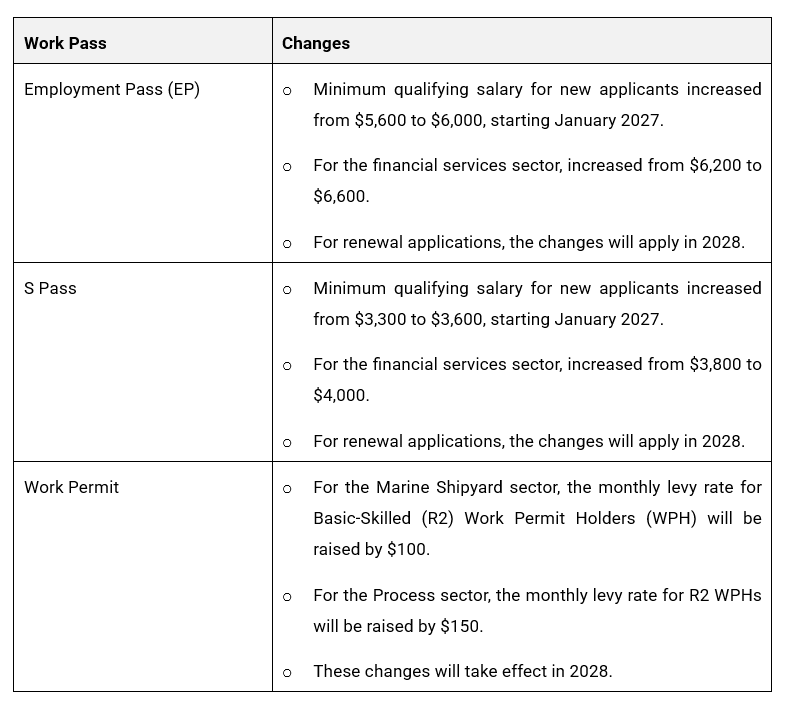
Businesses should note these changes and assess how adjustments to wage floors, qualifying salaries, and levy rates may affect workforce planning, cost structures, and hiring strategies going forward.
AI as a strategic advantage
Singapore intends to make bold moves in the AI space. The approach is not to compete in building the largest frontier models but rather in deploying AI effectively, responsibly, and at speed. Singapore aims to position itself as a trusted global hub where companies and researchers can collaborate to develop, test, and scale meaningful AI solutions.
- Launch of national AI Missions – The Government will launch a set of national AI Missions to transform key sectors using AI; namely: advanced manufacturing, connectivity and logistics (including airport and seaport operations), finance and health care. This will involve the Government working closely with industry to identify problems in these key sectors and to align research and development, regulatory and investment promotion efforts to accelerate the development, testing, deployment and scaling of AI solutions.
- New National AI Council – A new National AI Council, chaired by the Prime Minister, will provide strategic direction and oversee the implementation of Singapore’s AI ambitions. The Council comprises key economic, digital, manpower, and infrastructure ministers, and will also draw on private sector expertise. The council’s mandate includes unlocking regulations to accelerate the development, testing, deployment and scaling of AI solutions.
- Tax deductions – The Enterprise Innovation Scheme will be enhanced for YA 2027 and YA 2028 to include AI expenditures as a qualifying activity, capped at $50,000 per YA.
- AI park at One-North – Jurong Town Corporation will establish an AI park at One-North as a focal point for innovating, test-bedding and scaling AI solutions.
With these deepening national investments and structural moves into AI, businesses – especially those in the four key sectors – should anticipate greater regulatory attention on AI deployment and governance, but also more support for AI implementation. Singapore’s focus on key sectors suggests it is likely to continue regulating AI based on the present risk-based, sector specific regulatory approach, instead of introducing omnibus AI legislation as has been done in some other jurisdictions such as the EU and South Korea.
While the overall direction will likely evolve as the National AI Council progresses its work, it is clear that Singapore is looking to go full steam ahead on embracing AI.
Sustainability
Despite a slowdown in global climate momentum, Singapore emphasised that retreating from climate action is not an option, as environmental resilience is closely tied to long term economic competitiveness.
The Government will assess the post 2027 carbon tax trajectory carefully, recognising Singapore already has the highest carbon tax in Asia and must remain economically competitive. Even so, Singapore remains committed to its broader decarbonisation pathway, including the goal of achieving 100% cleaner vehicles by 2040, supported by incentives for electric vehicle adoption and an expanded nationwide charging network.
In the aviation sector, the Government is supporting demand for sustainable aviation fuel, while the maritime sector is progressing with the development of low carbon‑ammonia bunkering, which is an initiative that could make Singapore one of the first countries to supply ammonia as a marine fuel. If this initiative materialises, we anticipate that it could catalyse the development of a new ecosystem of supporting industries and services, including specialised bunkering operations, upgraded portside infrastructure, and expanded opportunities for companies involved in clean fuel logistics, storage, and technology solutions. It is also expected that new safety standards and regulatory frameworks will emerge as these technologies scale.
For further enquiries, please contact:
Ian Teo at ian.teo@helmsmanlaw.com
Zhida Chen at zhida.chen@helmsmanlaw.com
Una Khng at una.khng@helmsmanlaw.com
Lynette Koh at lynette.koh@helmsmanlaw.com
Su Yin Teoh at suyin.teoh@helmsmanlaw.com
Matthew Teo at matthew.teo@helmsmanlaw.com
Lester Ho at lester.ho@helmsmanlaw.com
Constance Leong at constance.leong@helmsmanlaw.com
Peter Huang at peter.huang@helmsmanlaw.com
Basil Lee at basil.lee@helmsmanlaw.com
Arjun Mital at arjun.mital@helmsmanlaw.com
Daniel Ho at daniel.ho@helmsmanlaw.com
This publication is provided for general information purposes only and does not constitute legal or professional advice. It does not purport to be comprehensive or address every aspect of the matters discussed. While we strive to ensure the accuracy of the information at the time of publication, we make no representations or warranties as to its accuracy, completeness, or suitability for any particular purpose. You should seek specific legal or professional advice before taking any action based on the contents of this publication. We do not accept any liability for any loss or damage arising from any reliance placed on this publication or its contents. No lawyer-client relationship is created by this publication.
We stand ready to help you capture the opportunities and navigate unchartered territory. To find out more, please feel free to contact us: